“Less Harsh, More Human” | Kent Jones, Late Fame
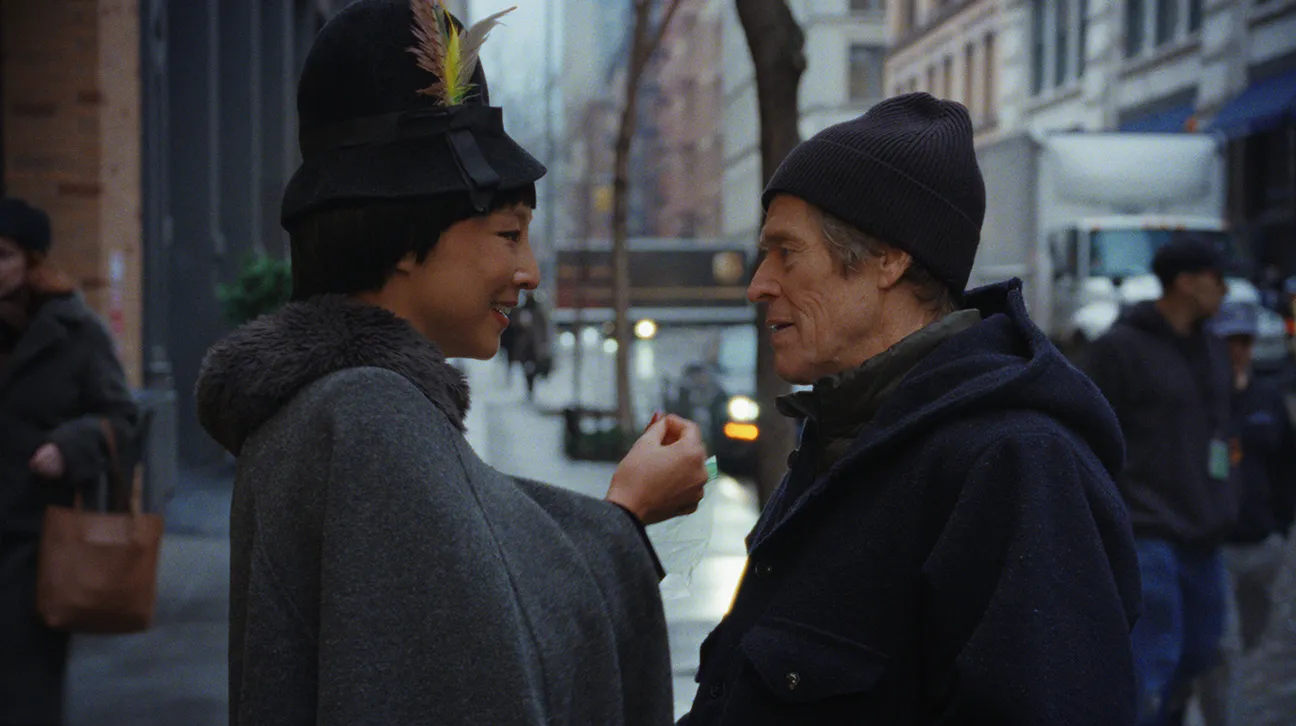
The great Willem Dafoe lends his delicate gravitas to the role of Ed Saxberger, a forgotten New York poet who works in the post office. After an eager and flattering young admirer (Edmund Donovan) appears on his doorstep, Saxberger is beckoned into a coterie of twentysomething admirers who anoint him as a rediscovered genius. Intoxicated by the attention—and by the alluring presence of Gloria, the group’s “tragic heroine” (a sinuous, Kurt Weill–crooning Greta Lee)—Saxberger gradually reckons with the authenticity of his newfound poetic circle.
On the strengths of its sly and hugely entertaining script by Oscar-nominated screenwriter Samy Burch (May December), Late Fame delivers a wistful yet unromantic look at a lost idea of downtown New York. Screening Sunday, May 3, at 6:30 p.m. at the Music Box Theatre for the Chicago Critics Film Festival, Late Fame marks a thoughtful, witty second feature from Kent Jones (Diane).
Ahead of the screening, Jones graciously took the time to answer this year’s filmmaker questionnaire. Below, his individual responses.
How did you first become interested in filmmaking? What was your path toward directing your first film?
I got interested in filmmaking very early on. When I think back on it, my love for the film image always ran deep. And then that grew into what happened between the images. And then the interaction between the images and the sounds, the characters and their surroundings, the organic growth that happens in great movies (and doesn’t happen in bad ones—or, rather, they kind of grow like weeds), the rhythm that’s like a heartbeat… and on and on, deeper and deeper. I worked it out for a long time on paper, as a critic. Then, making documentaries about filmmakers. And then, fiction. In a sense, I’m glad that I started late because I didn’t make the kind of cinephilic stuff that would have come out of my 20s and 30s.
What inspired you to make the film you're bringing to the festival?
I got a call from Pam Koffler at Killer Films asking if I read scripts by other people, and that Samy Burch, who wrote May December, had adapted Late Fame by Schnitzler. I was intrigued. I went out and read the novella, and then I read Samy’s script. Willem and I later agreed that the script was better than the novella—less harsh, more human. Samy and I met, she loved Diane and was excited that I wanted to make the film, and then we started moving forward.
In the original draft, the reference points for the character’s past were earlier—the 60s and early 70s, the west village, the coffeehouses and the explosion of the Weathermen bomb on 13th street. When Willem got involved, we shifted it ahead by a decade to when he and I both arrived in New York. So that meant Soho, rather than the Village, and a world of poetry (there are many) I know very well. That was very important to me.
Tell us about a film that you consider a guiding influence (whether it has informed your overarching vision as a filmmaker, directly informed the title you're bringing to the festival, or both).
There are many. So many. They’re all in conversation with each other. Sometimes it’s a whole body of work—Hitchcock, Cassavetes, Bergman, Wilder, John Ford, Fellini, Lubitsch, Michael Powell with and without Emeric Pressburger, Jean Epstein’s ocean films, Naruse, Bresson, Pasolini. And then, some individual films that cut through me and really live within me: Shoah, The Best Years of Our Lives, Sauve qui peut (la vie), The Damned (the Visconti film), Not Reconciled, The Passenger.
But I’ll say this: I recently watched all of Chaplin’s feature-length films, some I was revisiting and one—A King in New York—that I was seeing for the first time. And I would propose that, when all is said and done, it’s Chaplin’s world and we just live in it. He was immense.
Tell us about a location that's held significance to the film you're bringing to the festival: a setting where filming took place, a geographic area that provided a source of inspiration, or another type of space that comes to mind for you in thinking about the film. What made this place so special?
Soho, Soho, Soho… The ghost of what Soho was haunts me. When I first got here, Soho was a very quiet place filled with lofts that were still occupied by artists. Many of them had gotten rich, but art and the creation of art was still felt down every vista and around every corner. And Anthology Film Archives and the Wooster Group (Willem!) and Richard Foreman were in Soho. And then, almost over night, around 1984, it was all gone. Now, as you walk the streets past all the billionaire dwellings and luxury-goods showplaces, what Soho was still feels present in some way. And, visually, from a distance, even as you get close to the cobblestones and the corrugated steel and the low horizon lines that come to a dead stop looking north to Houston and south to Canal. So… Soho.
The theatrical experience brings us together to celebrate artistic experience and expand our horizons as human beings. Tell us about a memorable theatrical experience from your life.
When I grew up in western Massachusetts, there were five movie theatres up and down Main Street, where I saw Cabaret and Mean Streets and the Godfather films and Chinatown and A Woman Under the Influence and Scenes from a Marriage and Nashville and Day for Night and annual revivals of Doctor Zhivago and Fantasia and so on. If you got me in a room, sat me down, and asked me to describe them, I could close my eyes and tell you about every seat, every piece of gum ground into every sloping floor, every crack in every carving on the walls, the smell of popcorn and the taste of Junior Mints. And through the mid-70s, they were all packed. Every show…
