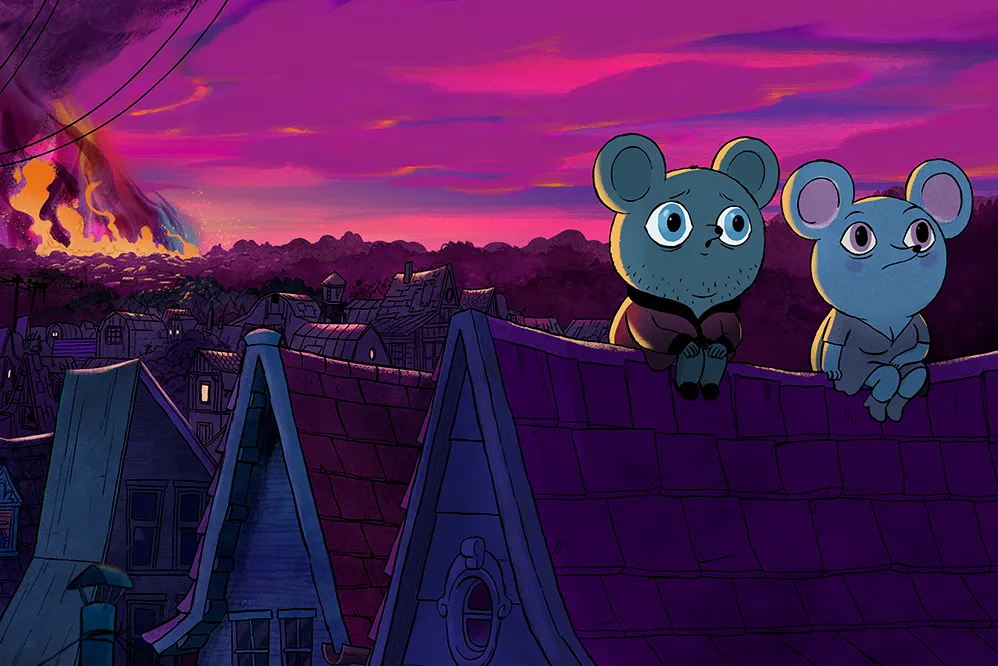
Something is wrong in the city of Anywhere. Arnold, an unemployed middle-aged mouse, confides to his wife Maria that he suspects his entire world is nothing more than a set, and his life a scripted performance. When his best friend Ramiro dies under mysterious circumstances, he traces the conspiracy to a monolithic corporation whose influence reaches every corner of their daily lives.
Adapted from the acclaimed 2016 short film by director Alberto Vázquez (Birdboy: The Forgotten Children, Unicorn Wars), Decorado blends biting humor with haunting beauty in a darkly surreal odyssey through our era of social control, manufactured realities, and the quest for authentic human connection. Co-presented by Animation Adventures, Decorado screens Friday, May 1, at 12:00 a.m., at the Music Box Theatre, as the opening Midnight film for the Chicago Critics Film Festival.
Ahead of the screening, Vázquez graciously took the time to answer this year’s CCFF filmmaker questionnaire. Below, his responses, which have been edited and condensed.
How did you first become interested in filmmaking? What was your path toward directing your first film?
I became interested in cinema when I was very young. It was always one of my great passions. But when I went to school for Fine Arts in Pontevedra, Spain, I discovered comics. That was a revelation for me because they allowed me to tell stories visually and graphically. This really connected with my way of expressing myself, since I have always loved drawing.
For a period of my life, I mainly devoted myself to comics and illustration, creating my own stories. And I think what is really interesting about animation is that it exists somewhere between those two art forms: between cinema and comics. It takes elements from both languages and blends them in a very natural way.
In my case, the move toward directing happened quite organically. In 2003, I published the comic book Psiconautas, and one day I received a call from the producer and screenwriter Pedro Rivero. We started working together on its adaptation: first we made the short film Birdboy, and later the feature film Birdboy: The Forgotten Children, which was also released in the United States. That was really my path into directing.
What inspired you to make the film you’re bringing to the festival?
This film comes from several different inspirations. On the one hand, there are the classic cartoons I have loved since childhood, especially the earliest Disney films and the broader cartoon tradition. That visual imagination, that freedom, and that ability to build worlds that seem friendly on the surface but are actually deeply strange have always fascinated me.
On the other hand, there is a very clear influence from the dystopian works I discovered in adolescence, such as 1984, Brave New World, and Fahrenheit 451, as well as series and films like The Prisoner and The Truman Show. I have always been very interested in the kind of science fiction that deals with artificial societies, systems of control, and realities that seem normal on the surface but are deeply unsettling underneath. In a way, I think those kinds of stories connect strongly with the present: we live in a time when megacorporations, artificial intelligence, governments, and laws increasingly shape the way we think, relate to one another, and understand the world.
Then there is also my own personal experience of life. The film has a lot to do with the way I look at the world, with my sense of humor, with a certain irony, and also with a pessimism that is sometimes part of my character. I am very interested in working from that mixture of the comic and the uncomfortable.
There are also influences from filmmakers who explored dark humor and absurdity in a brilliant way, such as Luis Buñuel, who remains a very important reference for me.
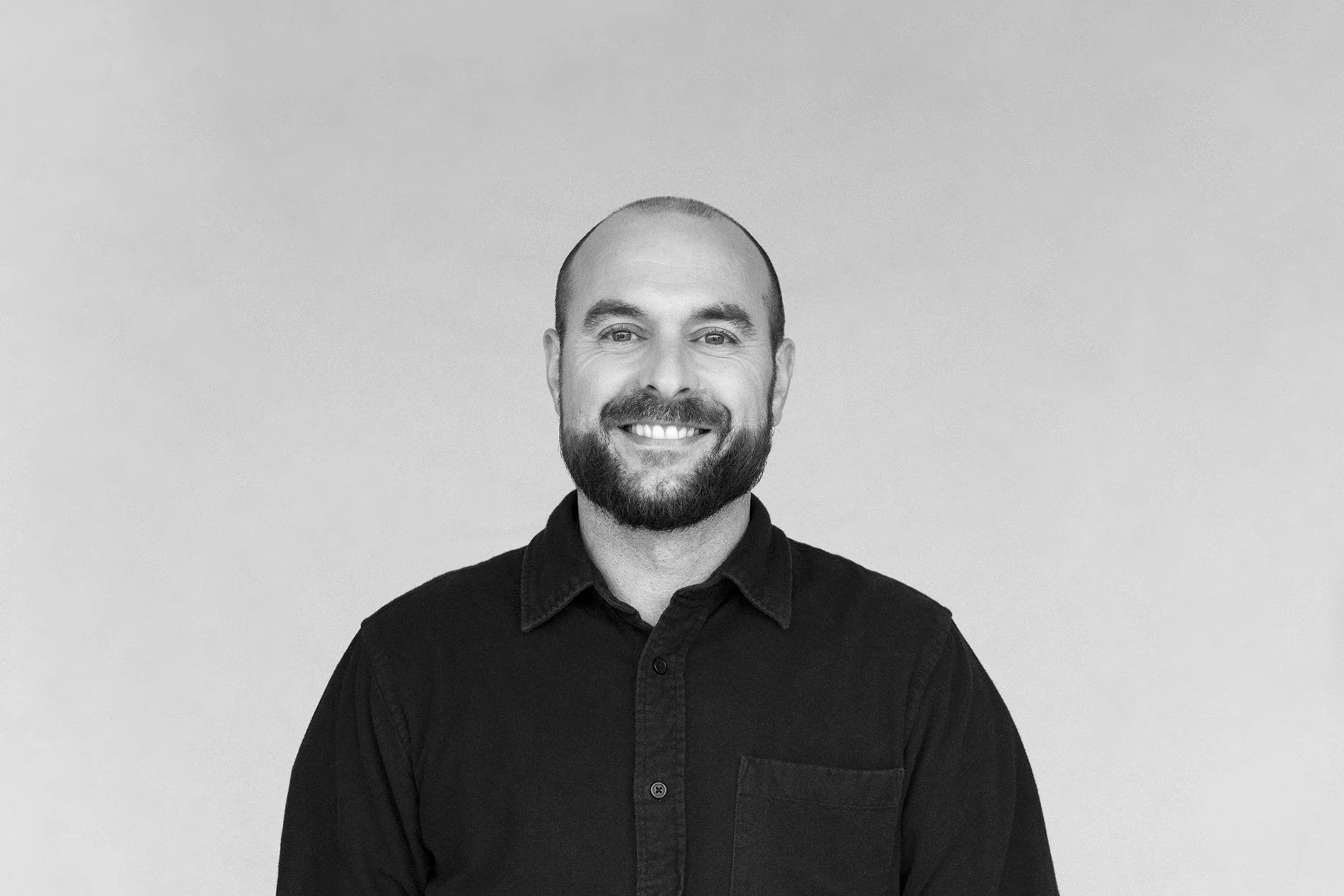
Albert Vázquez.
Tell us about a film that you consider a guiding influence (whether it has informed your overarching vision as a filmmaker, directly informed the title you’re bringing to the festival, or both).
One work I consider a very important influence is the British series The Prisoner. I think it is an incredibly modern work, both in its form and in its ideas. It blends spy fiction, science fiction, satire, absurdity, and philosophy in a very free and original way.
I have always been fascinated by a society organized through numbers, where you never fully know who really holds power. That sense of surveillance, manipulation, and loss of identity still feels very alive today, and it connects strongly with the world portrayed in Decorado.
In that sense, I think there is a clear relationship between the two works, because Decorado also mixes genres—humor, drama, horror, philosophy, absurdity—to speak about an artificial world and about characters living inside a system that shapes them without their ever fully understanding it.
Tell us about a location that has held significance to the film you’re bringing to the festival. What made this place so special?
In animation, there is not always a shooting location in the traditional sense, but there are real spaces that end up influencing the film very deeply. In my case, I often work from my own experiences and from the places I have known.
During my teenage years, I lived in a kind of suburban development that reminded me a little of the residential areas you see in American films like American Beauty: neat houses, gardens, an appearance of calm and perfect domestic life. It was a place that could seem idyllic and peaceful, but to me, it also felt deeply boring, cold, and impersonal.
If I had to point to one place that was important for Decorado, it would be that one. I think that feeling of artificial normality, of a kind of empty well-being, influenced the atmosphere of the film quite a lot.
The theatrical experience brings us together to celebrate artistic experience and expand our horizons as human beings. Tell us about a memorable theatrical experience from your life.
Today, going to the cinema is almost a cultural and even political decision. We can watch films at home in very good conditions, with large screens and good sound, but the movie theatre still offers something that cannot be replaced: a collective experience. You may go with other people or go alone, but you still share the film with others, and that completely changes the way you watch it and feel it.
The format also matters a great deal. And in the case of animation, seeing a film on the big screen is always especially beautiful because the image, the color, the sound, and the visual work all gain another dimension.
That is also why I think festivals are so important. They do not just allow people to watch films; they create a community. They are places where you can discover different kinds of cinema, meet other people, speak with directors, ask questions, and experience film as something alive and shared.
And if I had to remember one especially memorable theatrical experience, I would mention presenting Psiconautas at Annecy Film Festival. Seeing the film in a huge, packed theatre and feeling that response from the audience was very moving. At a festival like that, you really feel that animation occupies an important place and is given the value it deserves. For me, it was an unforgettable experience.
