“To the Women in My Family” | Judy Greer, Chili Finger
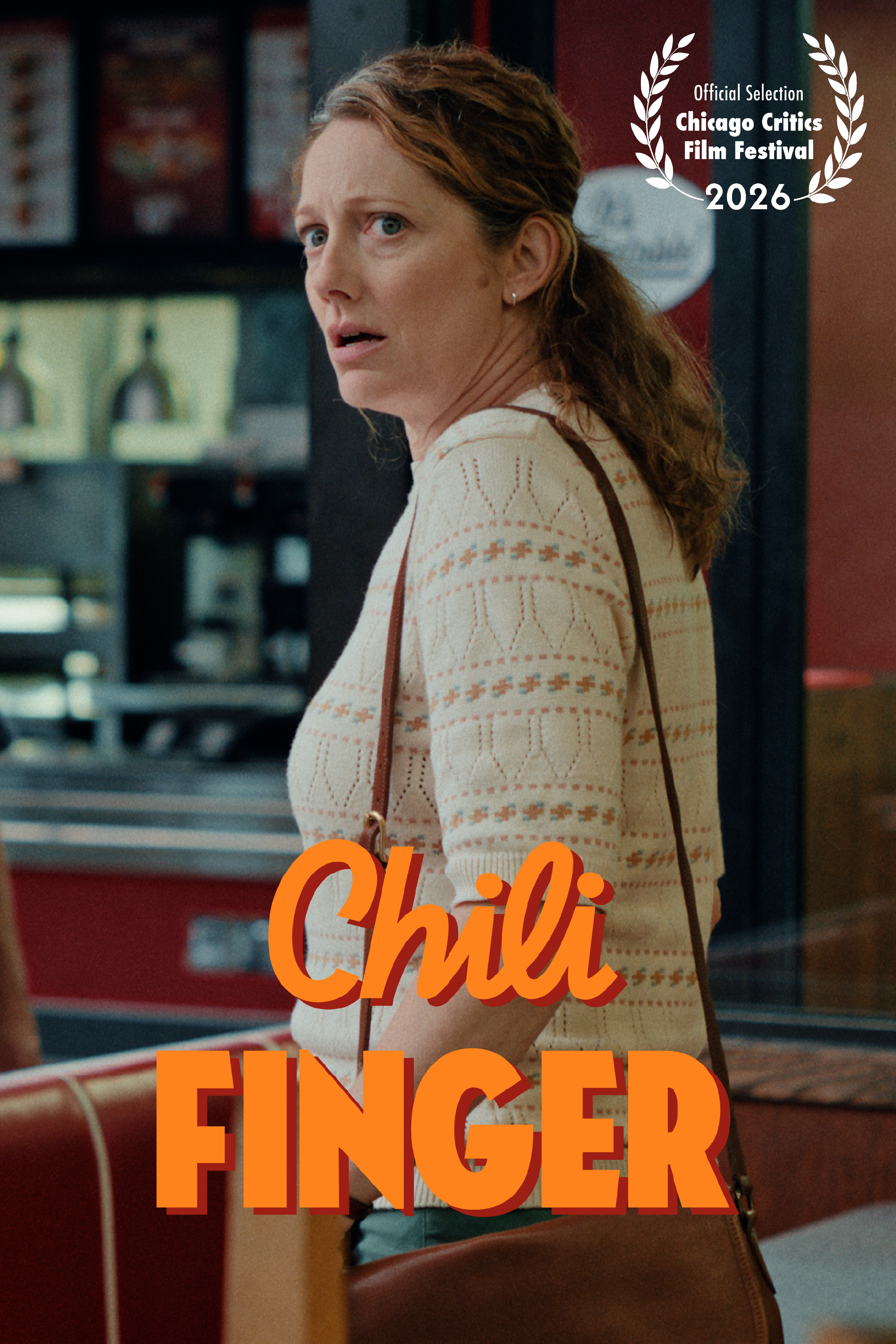
When Jessica Lipki discovers a severed human finger in her bowl of chili, she blackmails the regionally-beloved fast-food chain for $100,000 in return that she and her blissfully ignorant husband, Ron, keep quiet about the incident. Unbeknownst to Jess, her stunt has caught the attention of "the" Blake Junior, the plutocratic founder behind the "Blake Junior’s" food empire. He recruits his ex-marine buddy, Dave, to investigate Jess and discover the truth behind the chili finger...
Starring Judy Greer, Sean Astin, John Goodman, and Bryan Cranston, Chili Finger, from directors Edd Benda and Stephen Helstad, premiered on May 5 at the Music Box theatre in Chicago, as part of the Chicago Critics Film Festival. It was a magical night, with many of the local cast and crew in attendance for the Chicago premiere. You can read Benda’s and Helstad’s responses to our filmmaker questionnaire here. Greer took time to speak about playing Jessica, the restaurants that have held significance to her, and the art of crafting a good scream.
Minor spoilers for Chili Finger follow. This interview has been edited for transcription and clarity.
I had read that your mom was quite the rebel; she spent some time in the convent as a nun but then also went to nursing school. Did you find yourself thinking of her at all when embodying Jessica?
I'm excited for my mom to see this because I think she will see a lot of herself in it. She obviously is not this extreme, but I also wanted to dedicate my performance to my friends and my family, particularly the women in my family. For us, we all go through these times where you lose yourself and you don't know where you end and the other people in your life begin.
A core tension of the film is Ron’s adamance that he and Jess should still be able to eat at Junior’s. It’s a place that holds such significance and I wonder if there’s a restaurant or location, whether growing up or while filming, that has held that sort of primal power over you.
There are these Coney Island diners in Detroit that have always been a beacon for me always of my childhood and kind of high school years. When I was starting to go to places with my friends without my parents, I’d often go there because that’s what we could afford. IN LA there’s a bar restaurant called the Edendale in Silver Lake that is a real comfort place for me.
In Chicago, I have to shout out the Old Town Ale House. You can probably buy a big of chips and I’m always sneaking food in there (laughs) but those three places are ones that I wouldn’t want taken out of my life.
I’d like to think of this film as being bookended by screams. There’s the first scream your character utters when she finds the finger and then there’s–shall we say–a more incendiary one you do at the end. What is the art of a good scream?
For that first scream, I had an idea of what I wanted to do. I think what you see might have been my first take. When there's a moment like that in a performance for me in a script, I really like to start as high and as mighty as I can get and then go down from there. I’m always like “Let’s just fucking do it! Let’s go … let’s get the director the biggest, mightiest thing and then we can take it down from there if we need.” Sometimes I just need to get it out first so I can do other takes but sometimes, that’s the moment that appears in the film. It’s hard when you’re on set and there’s so many people there… for me, I needed to get that scream I was most scared out over with. I’m nervous too! I’m performing for a hundred people whether they’re watching me or not.
You have a contentious relationship with food in this film because you also have to throw spaghetti. Is there a similar mindset i.e. “I have to get this first throw out and then we can scale back” etc.?
Dude, that's scarier in a way because we’re a low budget, independent movie, we don’t have a lot of spaghetti, time, or turnover. I had to fucking nail it. But my stepson, Lucas, is a pitcher, and he’ll be proud and happy to know I threw something and hit it.
Jessica reminds me a lot of your character of Janice in Eric LaRue. Both women are wrestling with a storm of emotions, primarily confusion, on how to move on in their lives. They struggle with knowing where to place their grief in the film. Do you see a throughline with these characters?
Clearly neither of the characters I play knew how to handle anything (laughs). I might be tapping into something. I’m happy you reminded me of Mike’s film, because since I am the age I am, I am playing women who are in their midlife and they are confused and they are kind of stepping from one part of their life to another. I think that with Eric LaRue, it's a very different situation, but she is still on an island, and I think that there is something about not knowing what to do, not knowing who to go to, not knowing where to find help, and not even being able to identify the feelings that you're having maybe for the first time in your life. When you don't have the support of a spouse, a community, friends, family, you are left alone. I don't want to go into a whole spiel about mental illness, but these women, they did not have proper resources. With Eric LaRue we see the darkest version of it but in Chili Finger, we see someone who is just not resourced.
Chili Finger screened Tuesday, May 5, at 7:00 p.m., at the Music Box Theatre, for this year’s Chicago Critics Film Festival.
Zachary Lee is from Chicago’s North Side. A 2023 Chicago Film Critics Association & Rotten Tomatoes Emerging Critics Program Grant Recipient, he is a freelance culture writer who often writes about media, faith, technology and the environment. His words can be found at RogerEbert.com, Letterboxd, Interview Magazine, Filmmaker Magazine, IndieWire, Sojourners, and The National Catholic Reporter. You can find him on X and Letterboxd.
