“A Tribute to Everyone’s Youth” | Nick Davis, You Had to Be There: How the Toronto Godspell Ignited the Comedy Revolution
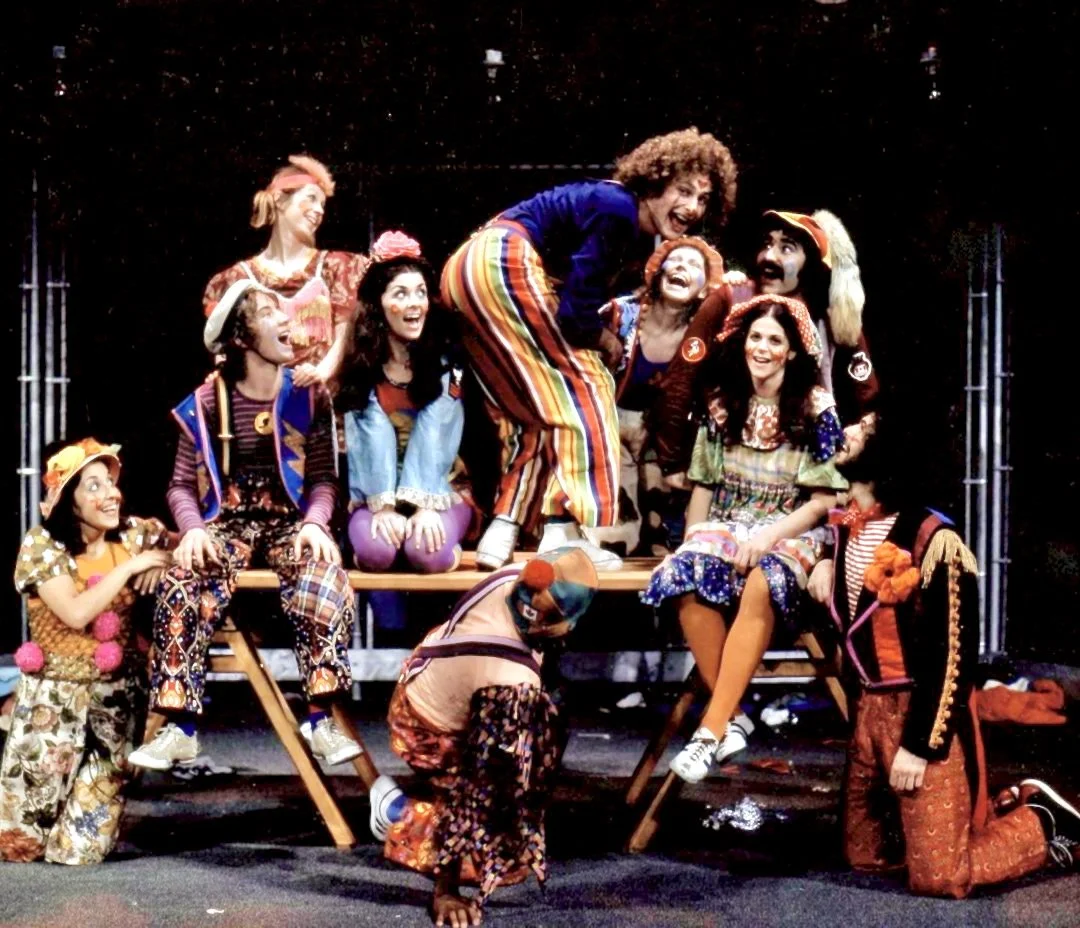
On June 1, 1972, a humble production of a hit musical retelling of the Book of Matthew officially opened its run at the Royal Alexandra Theatre in downtown Toronto. As for what happened next, that may be most accurately expressed by the subtitle for Nick Davis’ celebratory documentary, You Had to Be There: How the Toronto Godspell Ignited the Comedy Revolution, Spread Love & Overalls, and Created a Community That Changed the World (In a Canadian Kind of Way).
And that’s no empty boast about a bunch of singing hippies. Based solely on the bright futures of so many of the talents who formed the cast during the 14-month run — Martin Short, Eugene Levy, Gilda Radner, Victor Garber, Andrea Martin, Dave Thomas, and Jayne Eastwood plus musical director Paul Shaffer — Godspell’s impact and influence cannot be overstated. The improvisational element of the musical itself helped foster a unique sensibility that comedy fans would soon recognize in Saturday Night Live, SCTV, and countless other TV shows and movies.
As Davis’ film reveals, the Toronto Godspell was a hugely formative experience in the lives of the participants, too. With its deft mix of engaging interviews with surviving participants, animated recreations, and other means of compensating for the scarcity of original archival materials (if only audience members had smartphones in 1972), You Had to Be There brings this special time back into the present with an irrepressible sense of joy. — Jason Anderson, TIFF
You Had to Be There: How the Toronto Godspell Ignited the Comedy Revolution screens Sunday, May 3, at 11:30 a.m. at the Music Box Theatre, as part of the Chicago Critics Film Festival. Ahead of the screening, Davis graciously took the time to answer this year’s filmmaker questionnaire. Below, his individual responses.
How did you first become interested in filmmaking? What was your path toward directing your first film?
My hero growing up, though I would never have admitted it consciously, was my late grandfather Herman Mankiewicz, who wrote Citizen Kane with Orson Welles. Herman was one of the world’s great improvisational wits, but that was also part of the problem. He was someone who put his genius into his life rather than his art. However gifted, beloved, and larger-than-life, he was also a deeply frustrated and unfulfilled man, and he essentially drank himself into an early grave when my mom was fifteen.
I think I absorbed, without quite knowing it, both the romance and the danger of his example. In my youth, I became devoted to the improvisational life — to just winging it, getting by on charm and instinct, rather than discipline or planning. That can feel exciting when you’re in your 20s, but it’s not a great recipe for happiness, or for making good things, much less building a body of work.
Then, just before I turned thirty, with time running out on my becoming the genius of the millennium, I had a sort of brain wave—or maybe a brain fart—and I decided to make a film about a New Year’s Eve party on the eve of the millennium, with everyone confronting their own oversized expectations. The film itself would be made in a similarly loose spirit: shot with a lot of improvisational energy, light on plot, and suffused with self-reflexive wit, emotional distance, and anxiety.
And look, I’m proud of the film. It had a terrific cast of then-unknowns—Amanda Peet, Jennifer Garner, Timothy Olyphant among them—as well as Dan Futterman, Buck Henry, and Steven Wright. And it isn’t exactly a bad movie… but a film about massively self-absorbed New Yorkers was perhaps not designed to set the world on fire, and it left me with a Mariana Trench of credit card debt that took years to climb out of. My Uncle Frank may have put it best when he called me after seeing it and said, “I was watching the film for about thirty or forty minutes, and then I realized: ‘Oh! I don’t have to like any of these people!’ After that, I enjoyed myself.”
What inspired you to make the film you're bringing to the festival?
As a lifelong comedy fan, I don’t remember a time when I was not aware of the 1972 Toronto production of Godspell – how this one production starred some of the greatest performers of the last half-century and ignited the comedy revolution, the root of a tree whose branches would bear fruit like Saturday Night Live and SCTV, as well as a host of TV and movies continuing to the present day.
But something about the Godspell crew never made any sense to me.
As much as I loved the performers in that production—Gilda Radner, Martin Short, Eugene Levy, Andrea Martin, Dave Thomas et. al were obviously some of the funniest people who had ever lived—how in the world had they all come from Godspell?
My impression of the show had been formed by a too-young visit to the musical as a seven year-old and a general sense, not helped by exposure to the 1973 movie, that the show was sappy and soft, a kind of hippie-dippy kids show about Jesus, an amusing relic of the ‘Kumbaya’ peace-and-love 1960s.
So how, I wondered, had all this searingly brilliant comedy come from such a wellspring?
Was it all a massive coincidence?
And then, in the summer of 2017, I read Martin Short’s biography, and learned that he and Gilda had dated, off and on, for two years during the run of the show and afterwards. When I mentioned this to my wife Jane, it sparked a more serious interest in the project. Jane loved Gilda’s work as a kid, and we were both fascinated by what it must have felt like for the two of them to be in love, performing together and hanging out with their best friends.
We began the documentary.
As often happens, many preconceptions have been shattered along the way.
First of all, having made the film, we now understand the brilliance of the musical Godspell itself — which has a totally unfair reputation among those who don’t actually know the show. Far from being sappy, it is radical, returning the story to the essence of Jesus’ teachings: namely, to love your neighbor. And even more radical at the time was what Stephen Schwartz called book writer John-Michael Tebelak’s genius insight: here was a story that had been around for two thousand years, but no one before had realized it was funny. Jesus himself, and all his disciples, were entertainers — clowns. If they hadn’t been, their message wouldn’t have resonated.
Which is why it was no coincidence at all that these gifted comic performers were all attracted to Godspell in Toronto in 1972.
I should add that for many years I was devoted to performing improv comedy. (To this day, my wallet holds the first—and just about only—dollar I ever earned from improv.) When I was hanging out with my college improv group, or later, when I was performing in New York in the late ‘80s, I often found myself looking around at my fellow performers and wondering if we were like that Godspell gang, destined for greatness.
So how could my love for improv not have bled into the making of this film? The memories of those days and late nights with my friends, even though we didn’t go on to the careers that the Godspell cast enjoyed, bring me the same kind of joy as they bring the Godspell cast. As Victor Garber told us in his interview for the film, “These people are a part of my DNA.”
So my own desire to celebrate this magical moment is also I guess a tribute to youth — to everyone’s youth, when working and playing with your best friends is a dream you never want to end.
Tell us about a film that you consider a guiding influence (whether it has informed your overarching vision as a filmmaker, directly informed the title you're bringing to the festival, or both).
I grew up a Jewish kid in New York City in the 1970s, so the confluence of Woody Allen and Mel Brooks was wildly important to me. I inhaled Young Frankenstein and could literally recite the entire script — not just the jokes but the doctor stuff (“If we look at the base of the brain…. Give him an extra dollar… Hearts and kidneys are tinker toys! I’m talking about the Central Nervous System!”). Those two guys’ work, from Sleeper through Blazing Saddles and Young Frankenstein and Annie Hall, got into my bloodstream from an early age.
So making You Had To Be There felt sort of like a homecoming. Getting to interview comedy heroes and help them tell their story gave me the chance to make a film that I hope is imbued with that same feeling I may have absorbed from the Woody-Mel axis from the ‘70s: a spirit of comic looseness, affection, and heart.
Tell us about a location that's held significance to the film you're bringing to the festival: a setting where filming took place, a geographic area that provided a source of inspiration, or another type of space that comes to mind for you in thinking about the film. What made this place so special?
Toronto. As mystified as I was about this genius cast coming from Godspell, I was even more confused by the fact that they came from Toronto, as was Jane – who had actually lived there briefly in the ‘70s. As proud New Yorkers, we viewed Toronto as a deeply unimportant place, and we saw Canada in the early ‘70s as similar to England in the ‘50s, a drab place waiting for the Beatles to come along and wave their magic technicolor wand. But we quickly learned that Toronto in the early ‘70s was a hotbed of incredible talent, and Gilda and Marty and the gang were actually in the center of a creative explosion. The problem was, there was virtually no cross-over between Canada and America back then, and the wall between the two countries’ entertainment eco-systems was virtually uncrossable. A confluence of events was about to change all that, and so the young talent in and around the Toronto area—college friends Marty and Eugene and Dave Thomas, as well as Andrea Martin and John Candy and Gilda and Paul Shaffer and Catherine O’Hara—was about to be exposed to the wider world.
The theatrical experience brings us together to celebrate artistic experience and expand our horizons as human beings. Tell us about a memorable theatrical experience from your life.
For reasons too strange and complicated to go into here, Jane and I ended up getting married on a Broadway stage on a Saturday night in New York more than thirty years ago.
At the time, it felt slightly embarrassing and ridiculous. My only explanation was defensive: “Look, it’s way less expensive than the other venues, we’ll all get to dance on a Broadway stage after the ceremony — and by the way, I’ve had more profound experiences in theaters than I have in churches or synagogues!” But looking back, I see that was actually the truth, and I no longer feel sheepish about it.
What I understand more clearly now is that the theater, though a place of fantasy and dreams, is also a place of truth. It’s where people gather to feel something real together. That’s part of what made that day so meaningful to me: all of our closest friends and family were there as Jane and I began a life together.
The memory of that day remains extraordinarily vivid to me—the date is embedded in all my passwords, which is probably not something to admit in print—and it means even more to me now, because Jane and I are working together professionally, building a company and hoping to make films that bring people joy, connection, and even some truth. So in retrospect, getting married in a theater feels less like an odd accident that happened to two fairly private people than the most fitting beginning imaginable.