“Healing Ourselves” | Francesco Sossai, The Last One for the Road
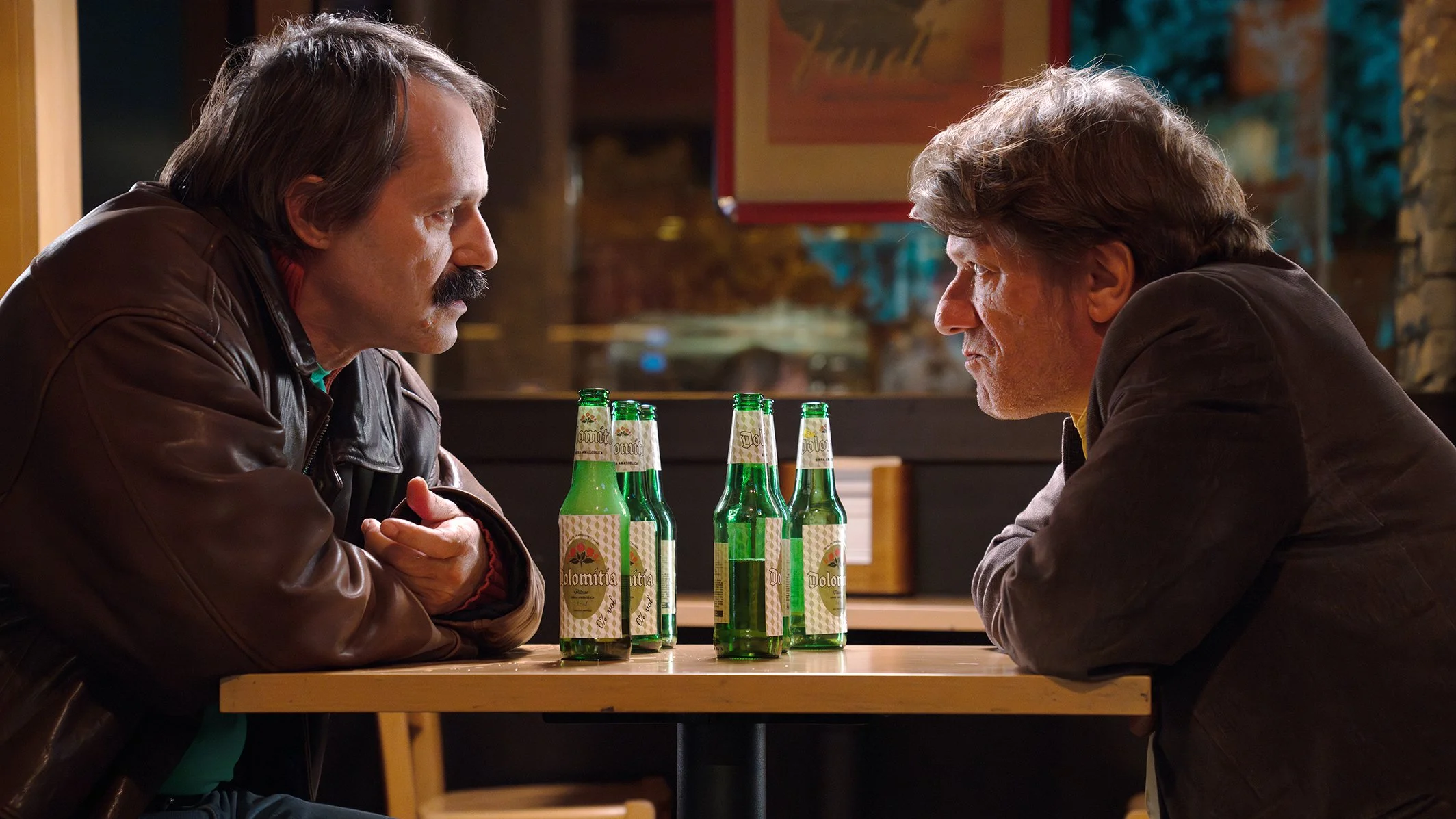
Two middle-aged friends, who swear each drink is their last, cross paths with a shut architecture student and take him under their wing on a free-flowing bender through the Italian countryside in a scruffy intergenerational odyssey.
Director Francesco Sossai’s dazzling sophomore feature is many things at once: a road movie, a casual caper, a tribute to a vanishing industrial Italy, a scruffy intergenerational odyssey, and free-flowing bender through time and space. The Last One for the Road screens Monday, May 4, at 4:15 p.m., at the Music Box Theatre in Chicago, as part of the Chicago Critics Film Festival. It is co-presented by the Italian Cultural Institute of Chicago's Moto Continuo Film Showcase. Ahead of the screening, Sossai graciously took the time to answer this year’s filmmaker questionnaire. Below, his individual responses.
How did you first become interested in filmmaking? What was your path toward directing your first film?
From an early age I felt an attraction to Cinema. Then one day I saw 2001: A Space Odyssey thanks to one of my teachers after school, and I felt I wanted to do this in life: be behind the camera. I started making films during the summer with my friends. So the high school years went by. Then the journey became circuitous: I studied English and German literature at university, tried making documentaries for a couple of years (without ever being able to complete them), and finally enrolled at DFFB, the film school in Berlin. But always I felt the need to return to my home region and tell the stories, people and landscapes that interested me. There I shot my first feature film, Other Cannibals, a no-budget film, within the course of my studies: it felt like the first accomplished thing I could do in my life. I was 31 years old when I finished it. From there, more years went by trying to turn this passion into a profession: The Last One for the Road is my first film produced by a production company and represents for me the landing place for a professional activity in the film world.
What inspired you to make the film you're bringing to the festival?
I wanted to tell the state of the Italian landscape, far from the picturesque depictions of Rome or Naples that have so imbued contemporary Italian cinema. I felt the urgency to narrate a form of life that is that of post-industrial Northern Italy.
To do so, I was inspired by a memory I had: ten years ago I spent with a close friend of mine, a weekend with an architecture student. We drank, walked, opened up to each other, visited architecture, we told him about our past while he fantasized about his future. The memory of the feeling of those days has stayed with me for years; I knew there was something significant in that feeling that inspired me to write about it.
Tell us about a film that you consider a guiding influence (whether it has informed your overarching vision as a filmmaker, directly informed the title you're bringing to the festival, or both).
The film that most inspired my filmmaking was definitely Dino Risi's Il Sorpasso. Risi used the genre of Italian comedy to make a powerful and ironic portrait of the Italian iconomic miracle, with its ideals, rituals, and miseries. What I wanted to do was to update that form of storytelling and see if it was still so effective at describing contemporaneity: instead of the economic miracle, I used it to describe post-crisis Italy in 2008.
Tell us about a location that's held significance to the film you're bringing to the festival: a setting where filming took place, a geographic area that provided a source of inspiration, or another type of space that comes to mind for you in thinking about the film. What made this place so special?
In a film about places like mine, every location was crucial. But surely the best memory I have is when we filmed at Carlo Scarpa's Brion Tomb: a masterpiece of twentieth-century architecture, a liminal work between memorial and land art. A work that holds echoes of Venice and at the same time of Japan (impossible not to think of the Golden Pavilion in Kyoto). I decided to film that space with the "tatami shot" technique invented by Yasujiro Ozu: that technique made the space unfold before my eyes as if it were a flower, allowed me to narrate and transfigure it by paying homage to an architect and a director I love very much, putting them unsuspectedly in dialogue with each other.
The theatrical experience brings us together to celebrate artistic experience and expand our horizons as human beings. Tell us about a memorable theatrical experience from your life.
I tell the last significant one: I had the good fortune to go and see with my editor a masterpiece that he edited twenty-five years ago: Il Mestiere delle Armi by Ermanno Olmi, in a splendid copy restored by the Cineteca di Bologna. I was in a terrible period of my life, I was psychologically shattered, but seeing that film put me back in the direction of healing: in the scene in which Giovanni Dalle Bande Nere has to face the amputation of his wounded limb, he decides to face this ordeal alone, without the help of the people who would like to be near him. I realized that I also had to face my pain and fear alone. This is the most powerful aspect of cinema: the ability to influence us to such an extent that we can somehow heal ourselves.
